

Link Score.
Analyse the PageRank of every page on your website with Screaming Frog’s Link Score
What SEO Spider’s Link Score is, the internal PageRank calculation from 0 to 100, and how the algorithm works. See how to enable it with Crawl Analysis and how to use it to assess the importance of your pages.
Understanding Link Score
Google’s PageRank was a ranking index used by the search engine to order web pages by importance, based on the quality and quantity of their inbound links. The public metric is long outdated, but the idea is still a useful reference when you look at a site’s internal linking architecture.
Since version 10, Screaming Frog has offered “Link Score”, an internal PageRank calculation on a logarithmic scale from 0 to 100 that ranks the importance of every single page. In short, pages that receive more links are considered more important (with a higher PageRank) than pages with fewer links.
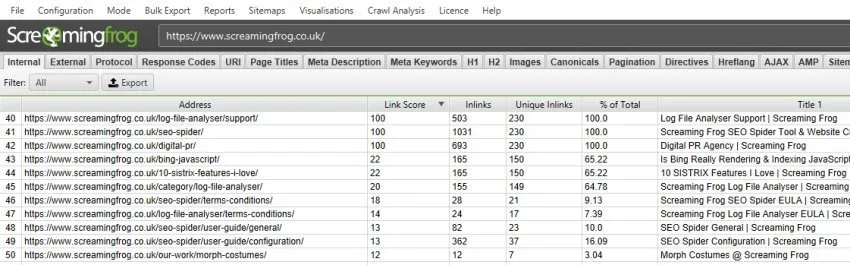
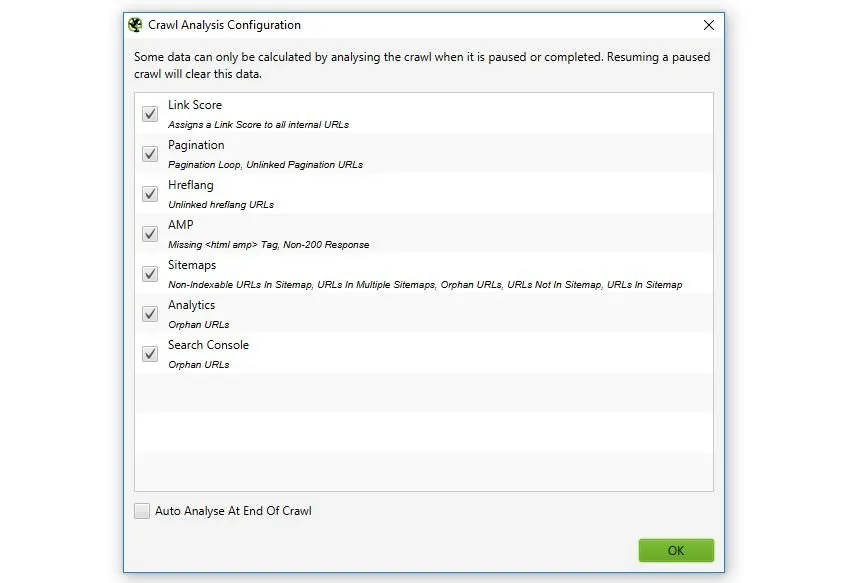
SEO Spider calculates Link Score at the end of the crawl through “Crawl Analysis”, which must be enabled from the configuration menu.
How Link Score works
The first step of the Link Score algorithm is to identify the subset of crawled URLs that are eligible, meaning they meet these criteria:
- they are internal to the subdomain;
- they are not redirects;
- they are not canonicalised URLs.
They have “AHREF” links pointing to them or are the target of a redirect or a canonical.
Once the eligible URLs are identified, each one gets a starting score of 1/n, where n is the number of eligible URLs.
In a second step, link score is passed between URLs according to their link relationships, with this formula:
Link Score = ((1 – D) / n) + (D * sum of the link score from inlinks)
where n is the number of eligible URLs and D is the damping factor. The damping factor controls how much Link Score flows between URLs. SEO Spider uses the commonly accepted value of 0.85.
Not every link counts towards Link Score. Only these link types are considered:
- AHREF.
- Canonical (HTTP/HTML).
- Redirect (HTTP/JavaScript/Meta Refresh/HSTS).
To pass Link Score, links must also be:
- not self-referencing (a URL can’t gain Link Score by linking to itself);
- unique (multiple links from URL A to URL B are ignored);
- without the rel=’nofollow’ attribute.
Note: Link Score skips redirected or canonicalised URLs and goes straight to their target URL.
For example, if URL A redirects to URL B, all links to URL A are counted as inlinks of URL B.
Link Score video tutorial
Questions about Link Score?
These guides come from real projects. If something in your crawl doesn’t add up, or you want to apply this process to your site, get in touch.
 Author.Raffaele Visintin.Search & Strategic Marketing Advisor
